

Editorial method
How We Review Men's Supplements
A supplement review is only as good as its method, so here is ours in full. We work from public information: product labels, brand pages, and retail listings in Indonesia.
What we do not do
We do not run laboratory tests, we do not accept payment for coverage, and we do not repeat health claims that a label or listing cannot support.
Every conclusion on this site traces back to a document a shopper could open in another tab. That constraint is deliberate. It keeps our reading of a men's vitamin formula tied to what the brand and the retailer actually publish, not to what would make an appealing review.
Our sources
Everything we describe comes from something a shopper could check. When a listing and a label disagree, we say so rather than picking the more flattering version.
That means our notes are reproducible. If you open the same product page and the same retail listing, you should be able to follow the reasoning in our write-up without anything hidden from view.
- Ingredient panel The full ingredient list and the amount printed against each item, exactly as the manufacturer publishes it.
- Serving size and count How many capsules or tablets the directions call for, and how many are in the bottle.
- Retail category Where a retailer files the product and who it is filed beside, which shapes what a shopper sees first.
- The brand's own page The manufacturer description, since brand copy often carries detail a marketplace listing trims away.
Ingredient transparency
If you cannot see the dose, you cannot compare the product.
First question for any product: can you see the ingredient list and the amounts? Proprietary blends that hide doses behind a single number score poorly here regardless of the brand. Transparent panels make comparison possible, and comparison is the entire point of this site.
Format and daily usability
We record capsules, tablets, softgels, and counts because those details decide whether a bottle survives its first month. A 120-tablet formula and a 60-softgel formula imply different routines. Reviewing format is not cosmetic; it is the most practical part of the assessment.
Someone who travels weekly and someone who keeps a bottle on the same kitchen shelf need different things from the same category. The format line in our notes exists so you can tell which routine a product is actually built for before you buy it.
Capsules
Easy to swallow and simple to split across a day if the directions allow it.
Tablets
Often the longest shelf presence and the most familiar option for a steady routine.
Softgels
Usually built around oil-based ingredients, with its own serving rhythm.
Bottle count
The number that tells you how quickly a purchase turns back into a decision.

Labeling and claim language
We flag labels that lean on dramatic promises, and we note when a product name suggests more than the panel supports. Stamina, vitality, and age-oriented cues are common in this market, and our job is to separate the naming from the nutrition information.
When a name promises energy but the panel lists a modest blend of B vitamins and minerals, we write that plainly. The name is a marketing decision. The panel is what you actually swallow, and it is the part worth reading twice.
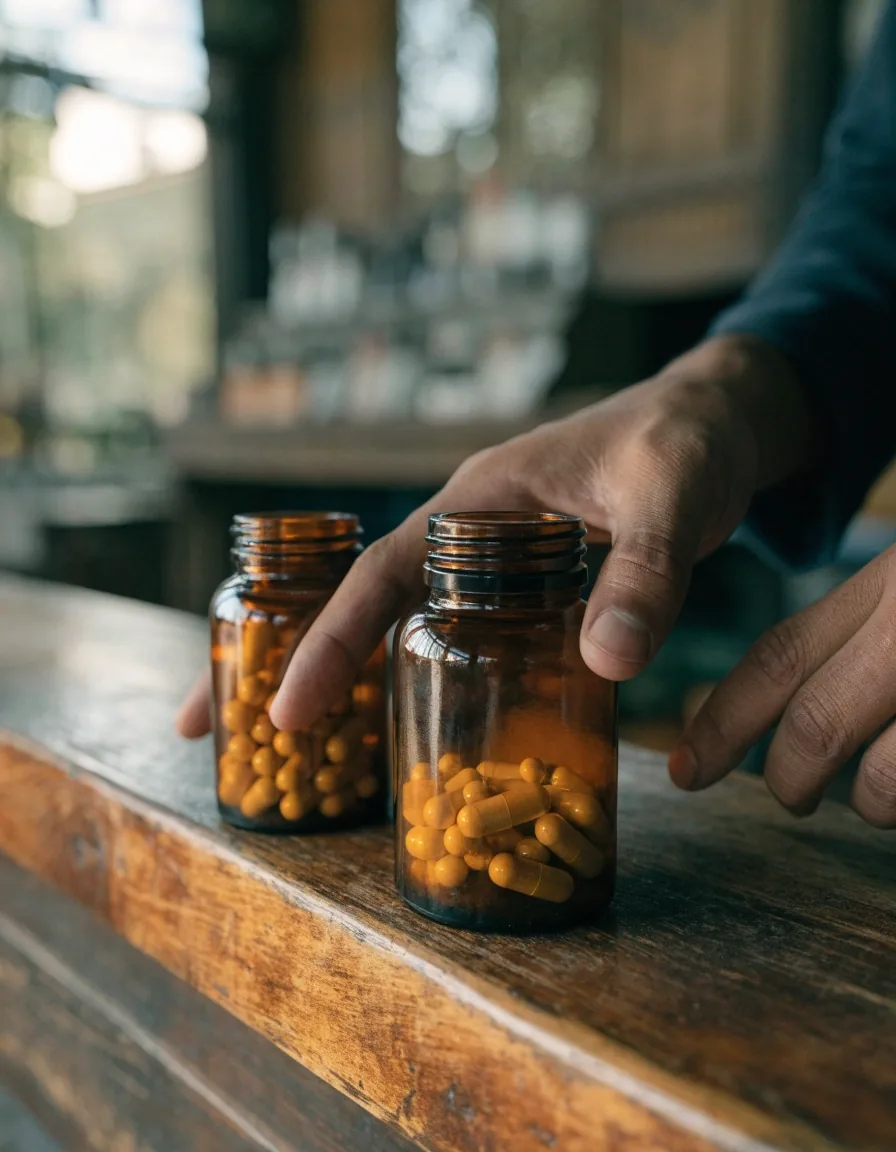
This is also why we avoid repeating claim language as if it were fact. A label that says a natural capsule supports strength and vitality is telling you how the product is positioned, so we treat it as positioning and look for the ingredient detail underneath it.
Brand and channel trust
Where a product is sold matters contextually. Shoppers cross constantly between pharmacy counters and marketplace listings, and each channel presents the same product differently.
We note the channel because it shapes what you see first, and because a product described one way on a brand page can appear very differently inside a marketplace bundle. Naming the channel keeps the source of each detail visible.
What we cannot assess
We do not verify manufacturing conditions, we do not test purity, and we do not evaluate products against medical conditions. Our notes stay on the label, the format, the channel, and the wording, because those are the parts a reader can check independently.
If you need guidance about a health concern, that belongs with a doctor or pharmacist, not with an editorial page. Nothing here is medical advice, and no supplement on this site is described as a treatment for anything. We write about ingredients, format, and intended use so you can make a more informed choice, not a clinical one.
Where the limits are real, we say so. A review that pretends to cover everything is less useful than one that tells you exactly where it stops.
Questions readers ask about the method
Do you test products in a lab?
No. We read labels, brand pages, and retail listings, and we tell you which of those a statement came from. Anything about purity or how a batch was produced sits outside what we can check.
How do you handle a product with a proprietary blend?
We note it clearly and we do not guess at individual doses. A blend that lists a total weight without per-ingredient amounts leaves a real gap in comparison, and we describe that gap instead of filling it in ourselves.
Does a brand pay to be covered?
No. Coverage is not sold and placement is not for sale. If a product appears in our directory, it is because enough public information exists to write about its ingredients and format in a way you could verify.
Can I ask you to look at a product?
Yes. Send a note with the product name and the page where you saw it sold. Requests help us decide what to write about next, though we cannot promise a date or that a given product will be covered.
How often are older entries updated?
When we notice a label change, a reformulated product, or a listing that has moved, we revise the entry. Reader notes are the fastest signal that something has shifted, which is why the correction route below is worth using.
Corrections
If a label changes, a listing disappears, or we describe something inaccurately, tell us and we will fix it. Send the product name, the page you read, and what looks wrong. Corrections from readers are the fastest way this method improves, and we treat them as part of the editorial work rather than a nuisance.
Email a correction
Reach us at [email protected] and include the product name where you spotted the problem.
When we reply
Monday to Friday, 9:00 AM to 6:00 PM, and Saturday, 9:00 AM to 1:00 PM. Notes sent outside those hours get reviewed the next working day.
Call the office
Ring +62 274 473 785 or write to Jl. Laksda Adisucipto Km 8, Maguwoharjo, Sleman, Yogyakarta, 55281.
Read a review knowing exactly how it was written.
The method above applies to every entry in the directory, from daily multivitamins and mineral blends to energy and endurance formulas and plant-based options. Start with the category closest to what you already take.